---
title: Universe
url: https://rone.dev/projects/universe
description: The Solar System where it is right now, at true scale, computed in the browser.
language: en-US
updated: 2026-10-31
translations:
id: https://rone.dev/id/projects/universe
---
# Universe
The Solar System where it is right now, at true scale, computed in the browser.
[Projects](https://rone.dev/projects) / [Web](https://rone.dev/projects/category/web)
Live · Started 2026
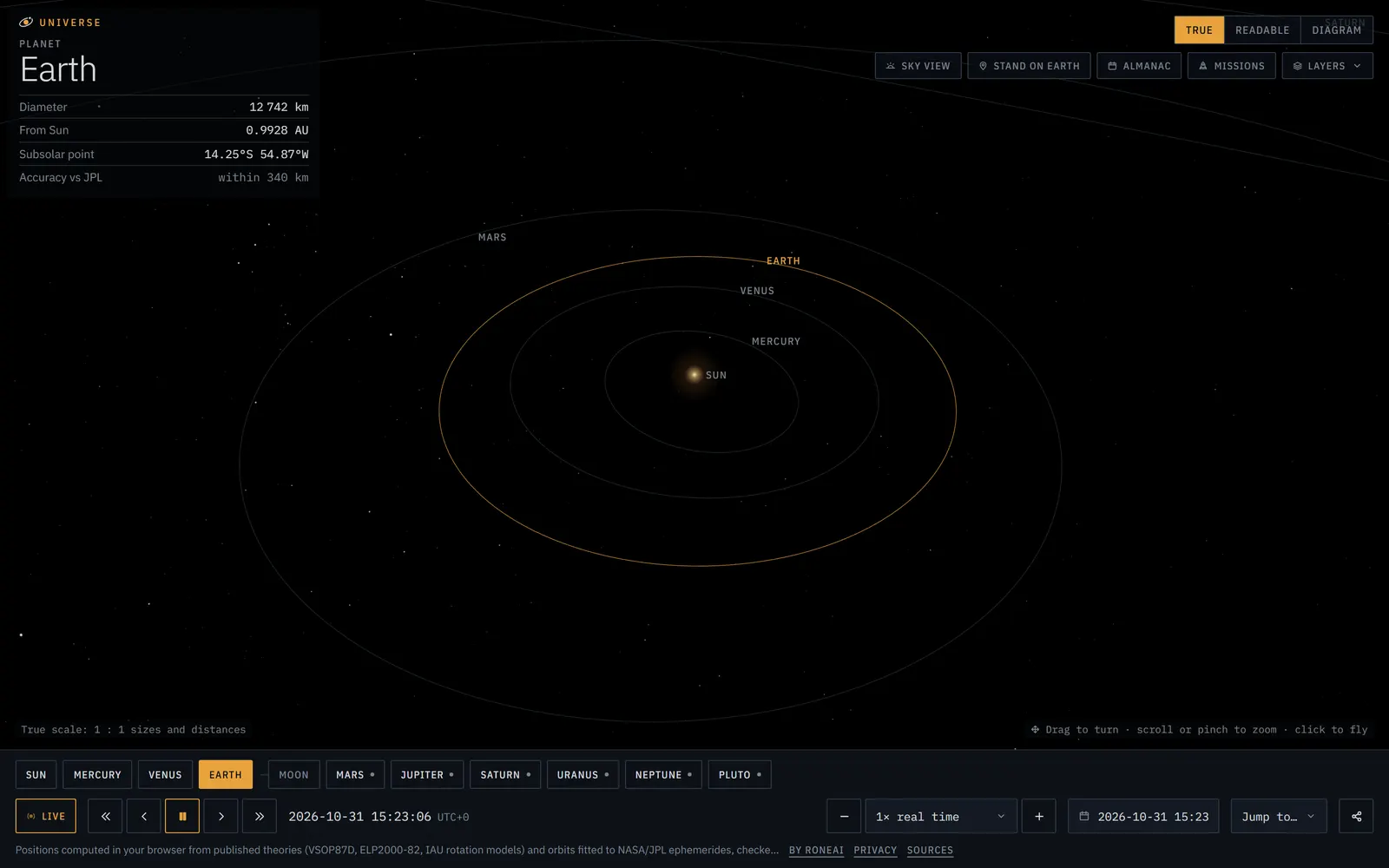
Universe draws the planets, their major moons and spacecraft at their current positions, with real orbits, lighting and eclipses. Positions come from published theories and orbits fitted to NASA/JPL ephemerides, computed in the browser and checked against JPL by the test suite.
## Numbers
* **21** Bodies
* **1 : 1** Scale
* **3** Map hosts contacted
## Project facts
| | |
| -------- | ------------------------------------------------ |
| Status | Live |
| Category | Web |
| Started | 2026 |
| Role | Design and build |
| Stack | Next.js, React, Three.js, WebGL, Vercel |
| Licence | Apache-2.0 |
| Links | [Live site](https://universe.rone.dev) · Private |
## Overview
Most Solar System views are animations: planets on circles at a speed that looks right. Universe computes instead. Each body sits where the published astronomy puts it at the moment shown, at its true size and distance, and the panel beside a selected body says how far that position is from JPL’s.
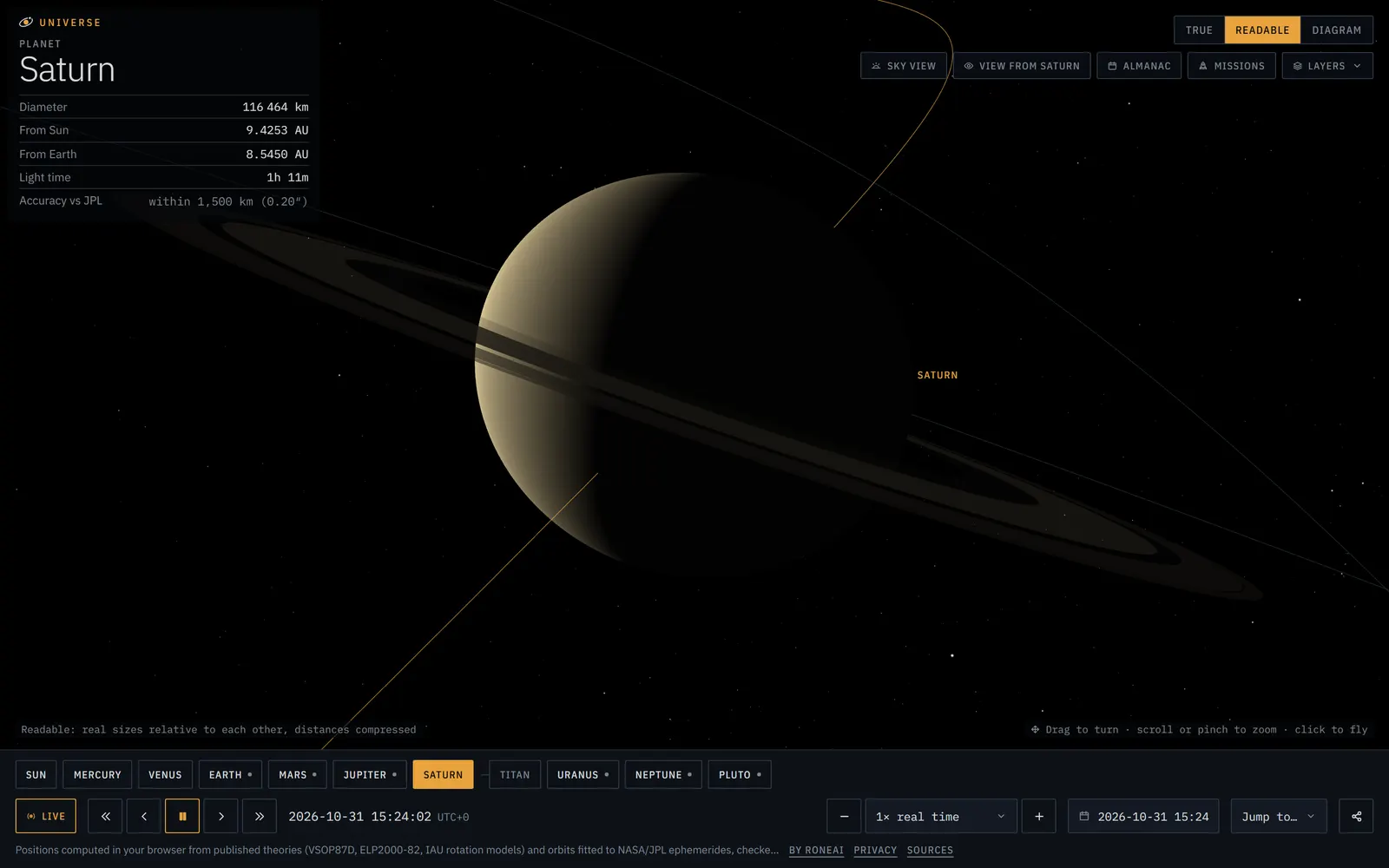
Twenty-one bodies are drawn: the Sun, the eight planets, Pluto, and eleven moons from our own to Charon. Time runs live by default and can be stepped, sped up, or jumped to a date, and a share link carries the moment and the view.
## Where the numbers come from
Planet positions follow VSOP87D, the Moon follows ELP2000-82, and rotation follows the IAU models; other orbits are fitted to NASA/JPL ephemerides. A truncated theory is cheaper than the full one and less exact, which is why the accuracy is printed against JPL rather than assumed. The star field is the Hipparcos catalogue, moved by its proper motions, with constellation figures from d3-celestial.
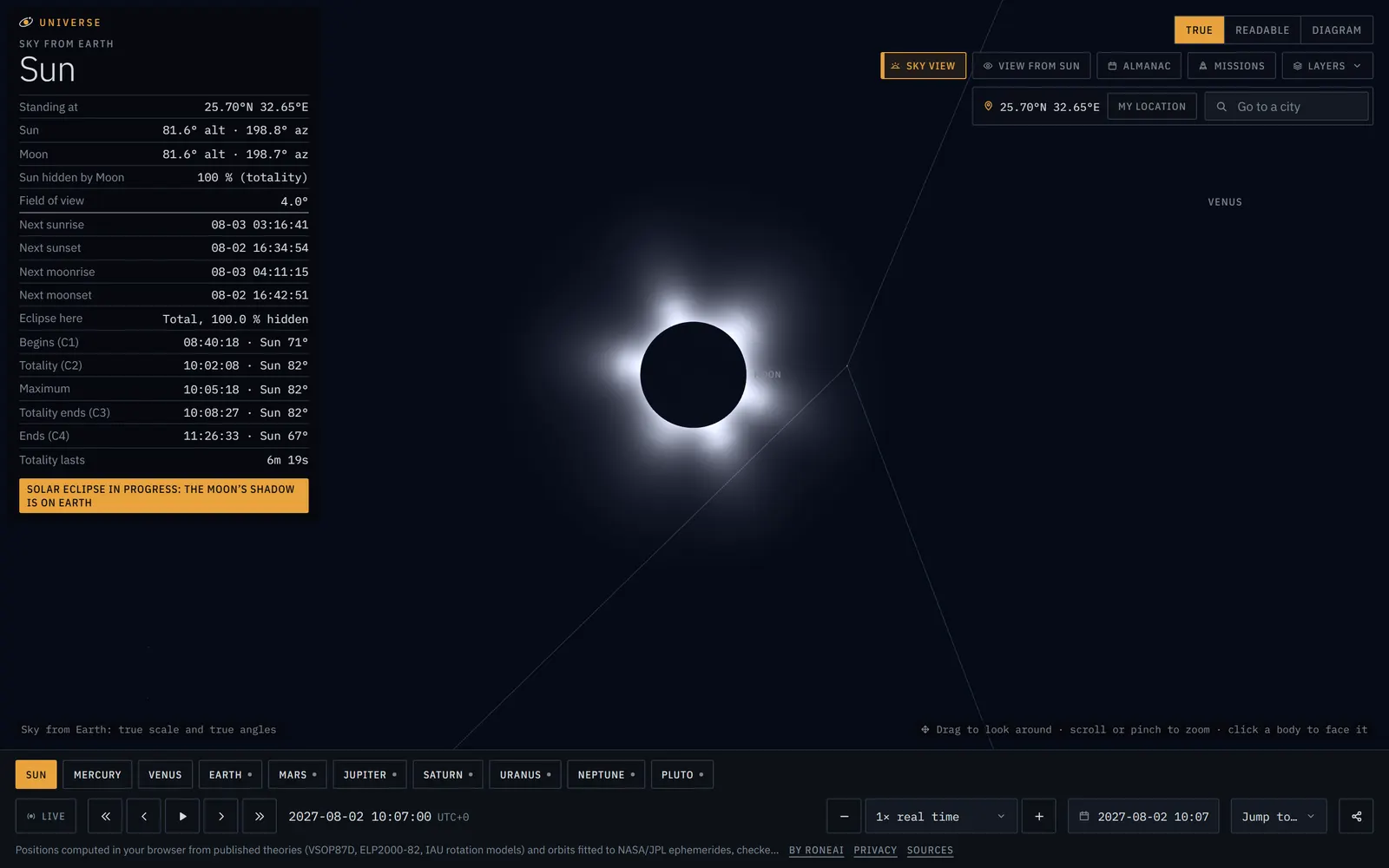
Because a true-scale Solar System is mostly empty space, the same scene has three scales — true, readable and diagram — and a sky view that stands on Earth and looks up.
## What it asks of the reader
There are no accounts, no analytics and no cookies, and the site has no server of its own: it is static files. Location is used only when the reader asks for their own sky, and a shared link carries it to about ten kilometres unless they choose the exact spot. Earth’s imagery and street map are the only things fetched from elsewhere, from three map hosts, and turning those layers off stops the requests.
pip install rone-arena — the whole API surface behind four sub-clients.
A Telegram bot that reads receipt photos with Gemini and files them into a spreadsheet.